
The gap between teaching and living.
On the uncomfortable distance between the life I write about and the one I actually live.

Welcome to issue #056 of Unsubscribe. Each week, I send one essay to help you step off the default path and build a life you love, supported by work you enjoy.
A few days ago, I was scrolling on X and came across a Tweet* showing how many famous self-help authors supposedly led miserable lives.
The guy who wrote “How to Save Your Marriage” shot his wife. Dale Carnegie, the legend behind “How to Win Friends and Influence People,” died alone. And parenting expert Dr. Benjamin Spock’s own sons tried to put him in a nursing home.
The tweet ended with this simple takeaway:
“They sell answers to life. They were just as lost as everyone else. Maybe even more.”
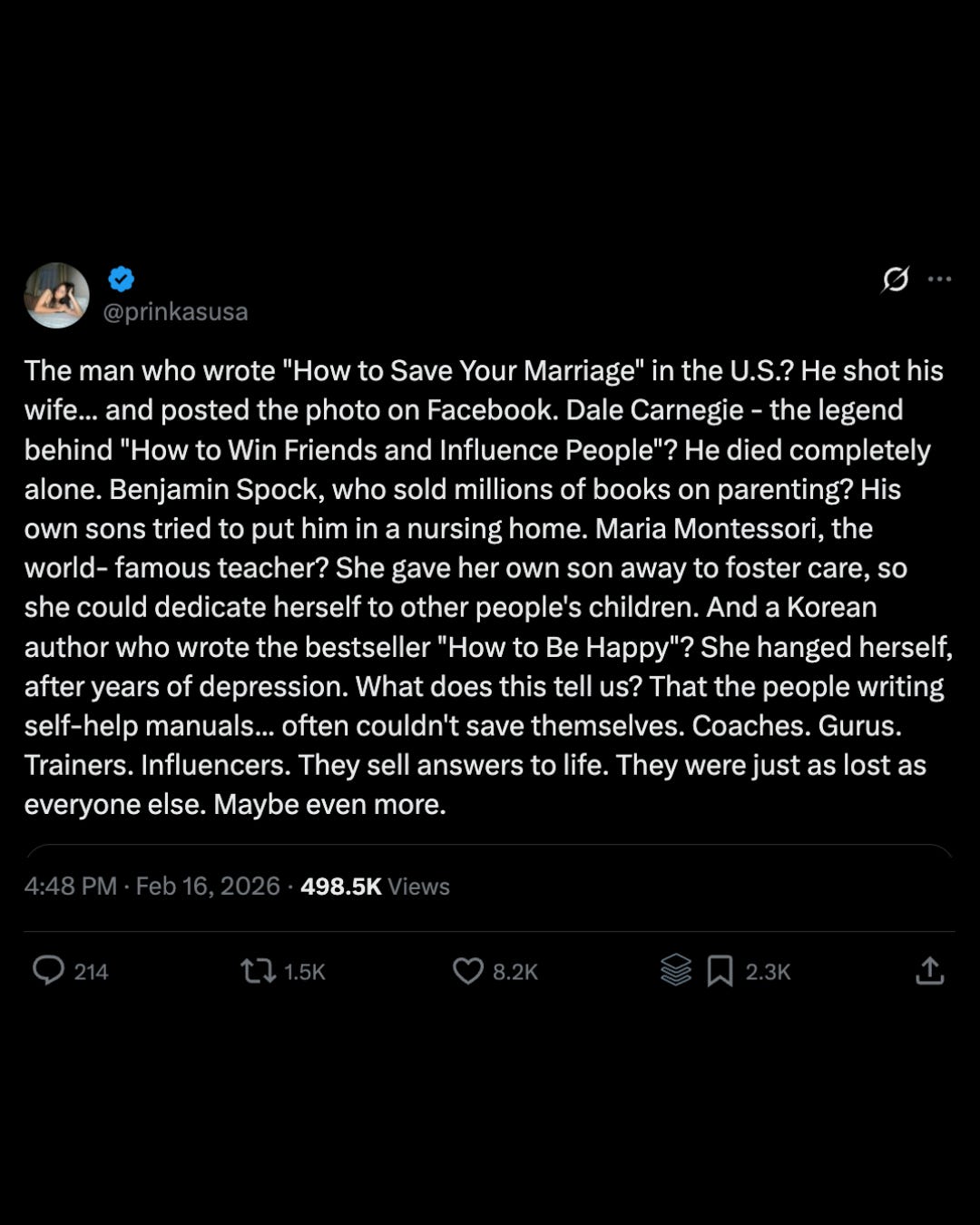
I wasn’t surprised to find this post had gone viral. People love nothing more than the idea that experts, influencers, and wealthy people are all secretly frauds. It makes everyone feel better about not having their own life figured out.
But the more I gave the post some thought, the more I felt that the author’s conclusion wasn’t correct.
I think the more accurate version is a bit simpler and a whole lot less satisfying:
Knowing how something works and being able to do it yourself are two completely different skill sets. They always have been and likely always will be.
I’ve seen this both personally and in practice.
I’ve spent the last seven years writing about how to build a business that supports your life instead of consuming it. I talk about freedom and flexibility, taking long lunches with my wife, mid-day walks, traveling, and more. We do all of that stuff, and I built my business specifically so that we can.
But I’d be lying if I said I always live exactly the way I encourage others to live.
There are weeks where writing two newsletters, forty or fifty pieces of social content, managing a membership community, and a partnership all take their toll. And at the end of the week, I look up and realize I’ve been staring at my laptop for five days.
Jennifer has been there, working alongside me, in the same house day after day, and somehow we’ve barely talked to one another. It doesn’t happen often, but when it does, it’s a reminder that living my values is a lifelong journey, not something you get perfect every week.
For example, last Tuesday was supposed to be an open day on my calendar for us to explore the town we’re currently living in. I had no calls, no immediate deadlines, and not much work to finish that day. That’s the whole point of how I set up my schedule.
But by noon, my schedule had been captured by some unexpected problems. A partner reached out and wanted to have an urgent meeting. Jennifer found a few problems in my newsletter that needed to be immediately corrected, and one of the pages on my website broke, so customers were having a hard time finding my product.
Jennifer asked if I wanted to grab lunch, and I said, “Give me thirty minutes.” Thirty minutes turned into two hours, and I can’t even remember if I closed my laptop.
But I know exactly how my week should look when I’m getting it right.
Open Tuesdays. No meetings. Protect the life you built. And I believe every word of what I write. But sometimes, a busy week shows up unexpectedly, and I do exactly what I tell 1.5M+ people not to do.
I don’t think that makes me a fraud at all. I think it makes me a person who’s better at seeing the pattern than executing it perfectly every time.
And I also think that’s true for most people who teach, write, or share what they’ve learned. It’s true for my friend who’s a fitness coach and knows exactly how to train, but skips his own workouts when life gets stressful. It’s true for the financial advisor I know who understands the poison of credit card debt more than anyone, and still carries it himself. It’s true for my old therapist, who could spot issues in her clients’ marriages, but couldn’t see them in her own.
I don’t consider any of these people hypocrites or frauds. They’re people who simply understand something intellectually and struggle with it practically. Knowing and doing have never been the same thing.
The gap exists because most advice is general, and life is very specific. When I write and encourage readers to “protect your time,” I mean that. But then a specific opportunity shows up that’s exciting or urgent, or a deadline gets tight, or a day stops feeling open because a bunch of new problems coincidentally land on my plate at once. And when that happens, the advice I wrote doesn’t feel like it applies to me anymore. Even though I’m the one who wrote it!
That’s part of the trap. You start to believe you’re exempt from your own lessons because you understand them so well. At that point, understanding tries to become a substitute for action, even when it isn’t. And nobody calls you on it because from the outside, it looks like you’ve got it all figured out.
I love it when Jennifer calls me on it. I’ve found that’s one of the biggest benefits of working with your spouse a few feet away at home. She doesn’t care what I wrote about last Saturday, if I’m not living it right now.
So, I don’t really agree with that tweet. The people writing those books might have been lost in a specific part of their personal lives, but I don’t think they became “go-to experts” without having massive success helping other people. Nearly all of them understand exactly what “good” looks like in their field. They just couldn’t do it consistently. And, I think if we’re all being honest, neither can most of us.
When I read books from experts, I don’t spend the majority of my time being skeptical about the usefulness of their advice. I simply keep showing up and trying to follow it, especially on the weeks when it’s hard. And I definitely try to follow the advice that I give, since I’m the one who’s writing it.
I don’t always get it right, but it will forever be a work in progress.
So here’s what I’m wondering this week:
What’s a piece of advice you fully believe in but still struggle to follow consistently?
Click the button below and tell me. I read every response.
If you enjoyed this read, the best compliment I could receive would be if you restacked this for your readers. Thank you so much for a bit of your valuable time today.
*Note: A few of the “facts” in the Tweet can be verified, while others appear to be false. Dale Carnegie did NOT die alone. Turns out I didn’t do enough diligence. I think this is both ironic and speaks to the topic quite well. Lesson learned!
Life is what happens when we’re busy making plans - even when the plan is to be less busy.
Living out what you write about is more about being authentic than perfect, and posts like these make me believe (without knowing you personally) that you’re authentic, and that helps more people than the illusion of perfection others are trying to represent.
The article rings very true, but the tweet that's mentioned might also have a much more prosaic explanation: it's just urban myths. Trying to search for the source of any of these claims doesn't surface any evidence for it being true. I suspect it's all made up.
As you wrote: it's not surprising it went viral. Successful people being frauds is super popular. It's easier to point and say "ha, they're actually worse than me" than it is to strive to improve.
Which makes the rest of your post even more important. Experts failing points to them being just regular struggling humans like the rest of us. Which makes it more realistic that maybe we could succeed. :)